
An open-access study published by Amgen researchers offers important evidence about the scalability and potential manufacturing benefits of controlled ice nucleation (CIN) in pharmaceutical lyophilization.
Published in AAPS Open, the article, From Laboratory to Production: A Journey of GMP Implementation for Controlled Ice Nucleation in Amgen’s Manufacturing Network, documents Amgen’s multiyear journey from technology assessment to GMP implementation across its manufacturing network. The authors describe it as the largest GMP deployment of controlled ice nucleation reported to date.
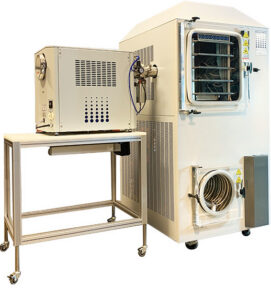
Amgen independently designed, conducted, analyzed, and published the research. Millrock Technology did not participate in the study. The researchers selected Millrock Revo® Pro freeze dryers equipped with FreezeBooster® for the laboratory-scale portion of their cross-scale analysis.
Where Millrock Technology Was Used
Amgen researchers conducted laboratory-scale controlled nucleation experiments using Revo Pro freeze dryers from Millrock Technology. The systems provided 0.74 m² of total shelf area and were equipped with FreezeBooster ice-fog generation modules.
According to the published paper, the laboratory equipment was used to generate data on freezing and drying behavior, product temperature, cake resistance, and heat and mass transfer. The Amgen team then compared laboratory-scale results with data generated using production freeze dryers ranging from 10 to 42 m².
The production-scale systems used technology from other equipment providers. Therefore, the study should not be interpreted as an evaluation of Millrock equipment across the full manufacturing scale. Instead, it provides independent evidence that data generated using Millrock’s laboratory-scale controlled nucleation platform can contribute to a broader scale-up and modeling strategy.
Key Findings from the Amgen Research
Amgen’s study reported several findings with important implications for controlled nucleation and pharmaceutical process scale-up:
- Post-nucleation cooling rates were highly consistent between the laboratory and production scales, with differences of no more than 1 °C per hour.
- Heat- and mass-transfer models parameterized with laboratory data predicted primary-drying product temperatures within 1.5 °C of production measurements.
- Controlled nucleation produced synchronous ice formation and supported more uniform freezing and drying behavior across sampled vials.
- Production-scale controlled nucleation cycles exhibited faster and more uniform sublimation than the non-CIN production cycles evaluated.
- Cake resistance was lower at production scale than at laboratory scale for the formulations and vial size studied, challenging assumptions used in some traditional scale-up models.
- The researchers successfully qualified controlled nucleation at production scale, including ice-fog generation and reproducible nucleation across the chamber.
These results apply to the formulations, vial configurations, equipment, and operating conditions evaluated by Amgen. The authors note that additional studies are needed to confirm some of the observed scale-up behavior across a broader range of formulations and vial sizes.
Why Controlled Nucleation Matters
In a conventional freeze-drying process, nucleation occurs stochastically. Individual vials may begin freezing at different temperatures and times, resulting in variations in ice crystal structure, cake resistance, drying behavior, and potentially finished-product characteristics.
Controlled ice nucleation creates a more consistent starting point by initiating nucleation across the vial population at a predetermined temperature. Greater control over this critical stage can help development teams reduce intra-batch variability, design more efficient drying cycles, and generate more representative data for modeling and scale-up.
FreezeBooster® introduces suspended ice crystals into the freeze-dryer chamber to initiate nucleation in supercooled product vials. In the Amgen study, researchers used FreezeBooster-equipped RevoPro systems to conduct the laboratory-scale experiments that informed their cross-scale comparisons and predictive models.
Independent Evidence Supporting CIN Scale-Up
The significance of the Amgen research extends beyond any single equipment platform. It provides independently generated, peer-reviewed evidence that controlled nucleation can be implemented at GMP production scale and that laboratory data can help predict important aspects of production-scale performance.
For development teams, the study reinforces the value of combining controlled nucleation with robust process characterization and predictive modeling. It also demonstrates the importance of selecting laboratory equipment capable of producing the high-quality data needed to support technology transfer and scale-up decisions.
Millrock Technology’s inclusion in this independent research reflects the use of Revo Pro and FreezeBooster as laboratory-scale tools within a rigorous, multiscale development program.
Read the Research
Read the full open-access article in AAPS Open:
From Laboratory to Production: A Journey of GMP Implementation for Controlled Ice Nucleation in Amgen’s Manufacturing Network
https://doi.org/10.1186/s41120-026-00145-7
Amgen independently designed, conducted, analyzed, and published this research. Millrock Technology did not sponsor or participate in the study. Millrock RevoPro® freeze dryers equipped with FreezeBooster® were used for the laboratory-scale portion of the research. Production-scale experiments were conducted using equipment and controlled nucleation technology from other providers. Reference to the study does not imply endorsement of Millrock Technology or its products by Amgen or the article’s authors.
Explore the Revo Pro Freeze Dryer